Notebook: Financial Analytics

PADS - Programa Avançado em Data Science

Insper

Paloma Vaissman Uribe

1. Exploring VAR - Vector Autoregression Models

Based on https://www.statsmodels.org/dev/vector_ar.html

Código

import numpy as np
import pandas
import statsmodels.api as sm
from statsmodels.tsa.api import VAR
from statsmodels.tsa.base.datetools import dates_from_str

mdata = sm.datasets.macrodata.load_pandas().data

# prepare the dates index
dates = mdata[['year', 'quarter']].astype(int).astype(str)
quarterly = dates["year"] + "Q" + dates["quarter"]
quarterly = dates_from_str(quarterly)
mdata = mdata[['realgdp','realcons','realinv']]
mdata.index = pandas.DatetimeIndex(quarterly)
data = np.log(mdata).diff().dropna()

# make a VAR model
model = VAR(data)
Código
data
realgdp realcons realinv
1959-06-30 0.024942 0.015286 0.080213
1959-09-30 -0.001193 0.010386 -0.072131
1959-12-31 0.003495 0.001084 0.034425
1960-03-31 0.022190 0.009534 0.102664
1960-06-30 -0.004685 0.012572 -0.106694
... ... ... ...
2008-09-30 -0.006781 -0.008948 -0.017836
2008-12-31 -0.013805 -0.007843 -0.069165
2009-03-31 -0.016612 0.001511 -0.175598
2009-06-30 -0.001851 -0.002196 -0.067561
2009-09-30 0.006862 0.007265 0.020197

202 rows × 3 columns

Código
results = model.fit(1)
results.summary()
  Summary of Regression Results   
==================================
Model:                         VAR
Method:                        OLS
Date:           Fri, 28, Nov, 2025
Time:                     22:40:39
--------------------------------------------------------------------
No. of Equations:         3.00000    BIC:                   -27.7388
Nobs:                     201.000    HQIC:                  -27.8562
Log likelihood:           1963.94    FPE:                7.37174e-13
AIC:                     -27.9360    Det(Omega_mle):     6.94859e-13
--------------------------------------------------------------------
Results for equation realgdp
==============================================================================
                 coefficient       std. error           t-stat            prob
------------------------------------------------------------------------------
const               0.003580         0.000911            3.928           0.000
L1.realgdp         -0.338056         0.172084           -1.964           0.049
L1.realcons         0.746283         0.130411            5.723           0.000
L1.realinv          0.057939         0.025349            2.286           0.022
==============================================================================

Results for equation realcons
==============================================================================
                 coefficient       std. error           t-stat            prob
------------------------------------------------------------------------------
const               0.006286         0.000775            8.114           0.000
L1.realgdp         -0.134053         0.146285           -0.916           0.359
L1.realcons         0.327751         0.110859            2.956           0.003
L1.realinv          0.042521         0.021549            1.973           0.048
==============================================================================

Results for equation realinv
==============================================================================
                 coefficient       std. error           t-stat            prob
------------------------------------------------------------------------------
const              -0.015808         0.004756           -3.324           0.001
L1.realgdp         -2.220857         0.898064           -2.473           0.013
L1.realcons         4.585966         0.680582            6.738           0.000
L1.realinv          0.300989         0.132290            2.275           0.023
==============================================================================

Correlation matrix of residuals
             realgdp  realcons   realinv
realgdp     1.000000  0.607456  0.759286
realcons    0.607456  1.000000  0.142791
realinv     0.759286  0.142791  1.000000
Código
# selection of orders of VAR: optimizing using information criteria
model.select_order(15)
results = model.fit(maxlags=15, ic='aic')
lag_order = results.k_ar
print("chosen VAR order is = " + str(lag_order))
chosen VAR order is = 3
Código
# forecasting: have to pass initial values
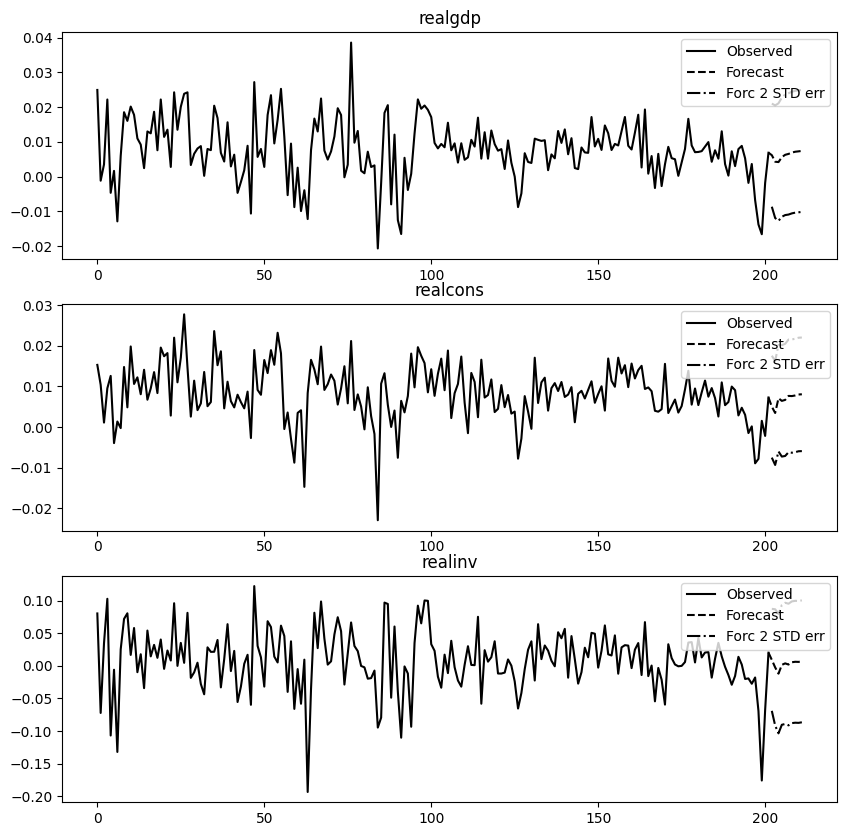
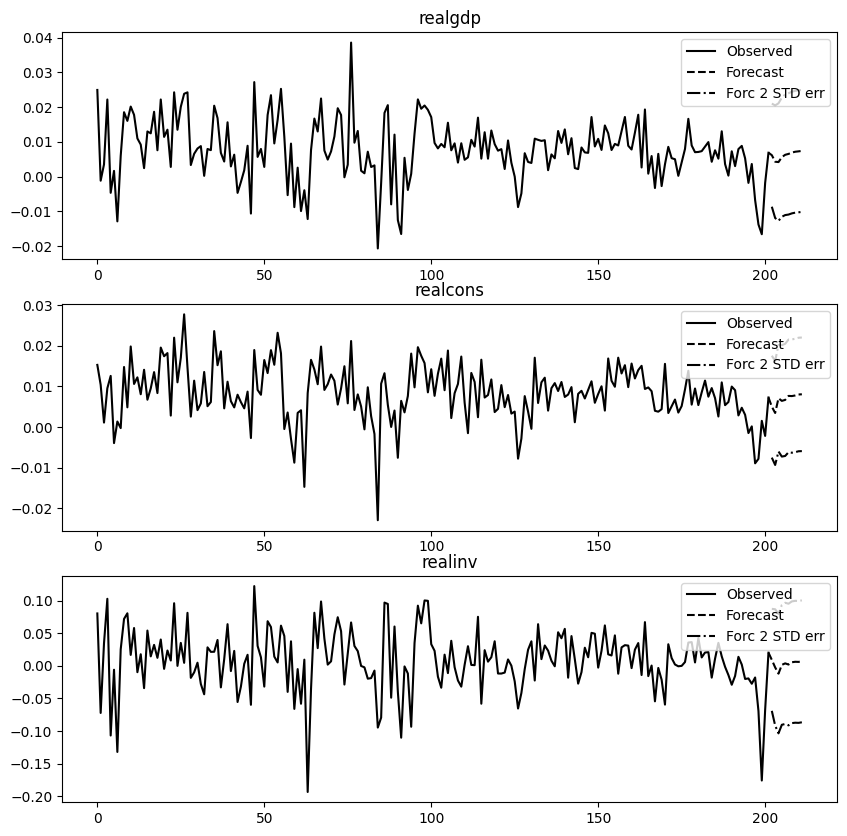
results.forecast(data.values[-lag_order:], 10)
array([[ 0.00616044,  0.00500006,  0.00916198],
       [ 0.00427559,  0.00344836, -0.00238478],
       [ 0.00416634,  0.0070728 , -0.01193629],
       [ 0.00557873,  0.00642784,  0.00147152],
       [ 0.00626431,  0.00666715,  0.00379567],
       [ 0.00651738,  0.00764936,  0.00198474],
       [ 0.00690284,  0.00760909,  0.00548495],
       [ 0.00714517,  0.00775843,  0.00620737],
       [ 0.007258  ,  0.0079993 ,  0.00602391],
       [ 0.00738975,  0.00804623,  0.00690895]])
Código
results.plot_forecast(10)

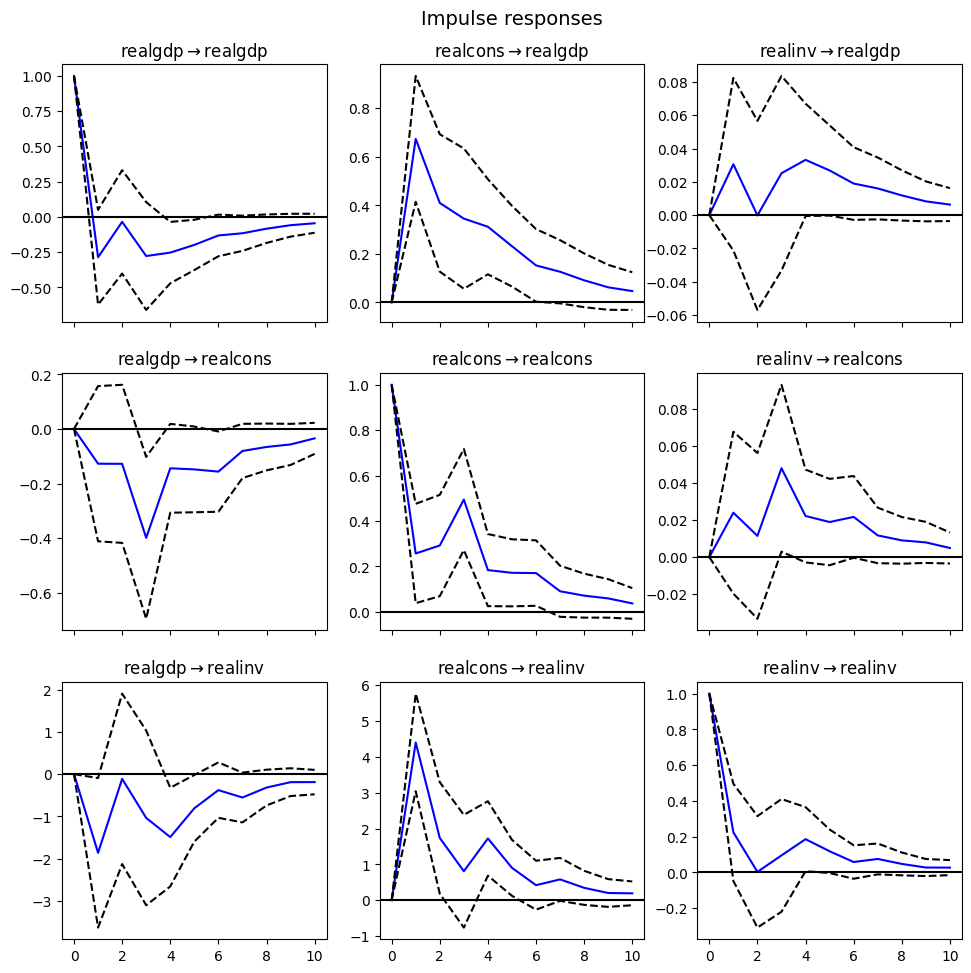
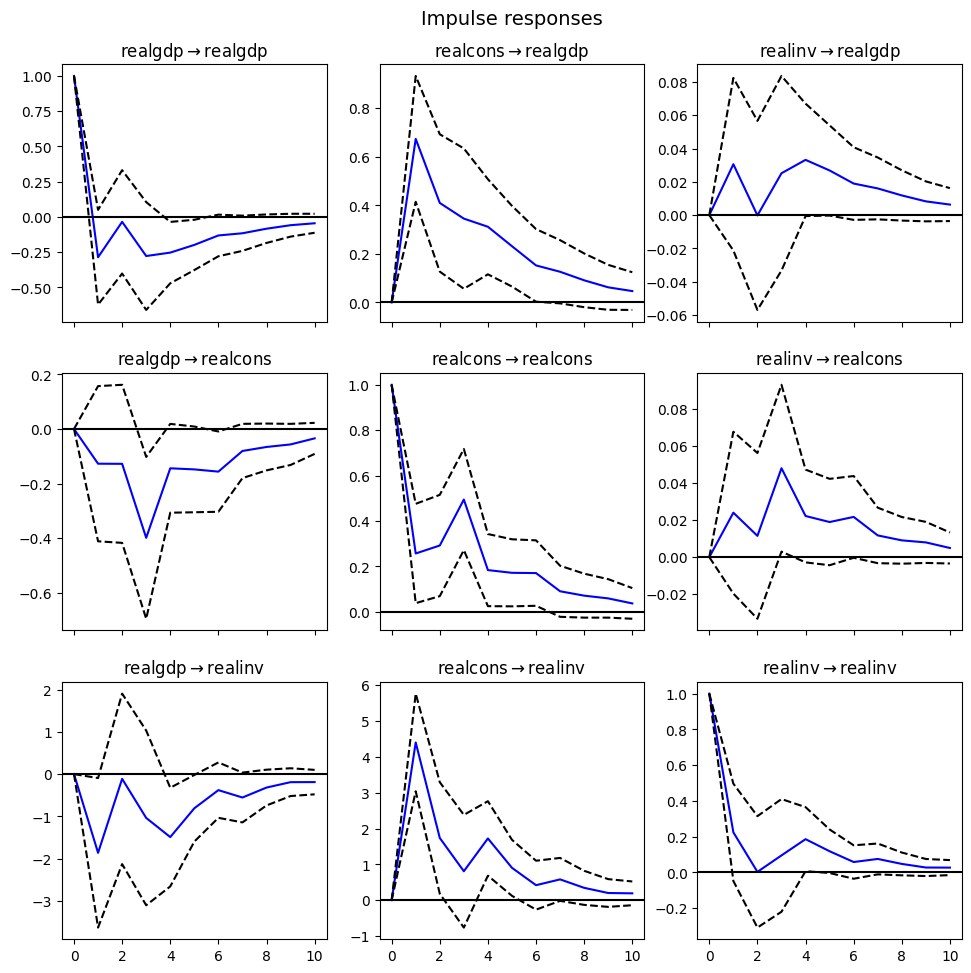
Impulse response function: how a system responds to a sudden change or impulse in its input in the time domain. In economics, and especially in contemporary macroeconomic modeling, impulse response functions are used to describe how the economy reacts over time to exogenous impulses, which economists usually call shocks, and are often modeled in the context of a vector autoregression.

Código
# impulse response function
irf = results.irf(10)
irf.plot(orth=False)

2. Exploring cointegration

Based on: - https://github.com/KidQuant/Pairs-Trading-With-Python/blob/master/PairsTrading.ipynb - https://www.programcreek.com/python/example/122726/statsmodels.tsa.stattools.coint - https://www.statsmodels.org/dev/generated/statsmodels.tsa.stattools.coint.html# - https://quantopian-archive.netlify.app/notebooks/notebooks/quantopian_notebook_145.html

Código
import pandas as pd
import numpy as np
from statsmodels.tsa.stattools import coint
from pandas_datareader import data as pdr
import datetime
import yfinance as yf
import matplotlib.pyplot as plt

A note on how to detect cointegration

Steps:

  1. Test for a unit root in each component series individually, using the univariate unit root tests, say ADF, KPSS, PP test.

  2. In the case we don’t reject the null hypothesis of unit root, we can apply Engle-Granger test:

It works in two steps: first, a regression is estimated between the variables and the residuals are extracted. Second, a unit root test, such as the Augmented Dickey-Fuller (ADF) test, is applied to the residuals to check if they are stationary. If the residuals are stationary, the original variables are considered cointegrated.”

The coint function from statsmodels.tsa.stattools performs the Engle-Granger two-step cointegration test.

Simulating some example data

  • Simulating prices using cumulative returns;
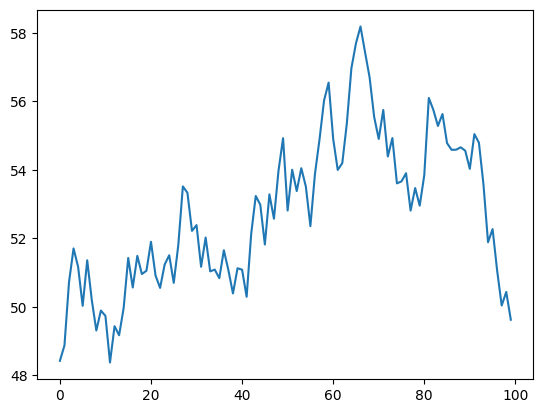
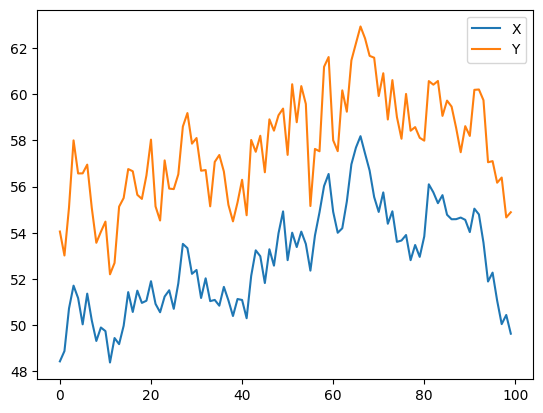
  • Now we generate Y. Remember that Y is supposed to have a deep economic link to X, so the price of Y should vary pretty similarly. We model this by taking X, shifting it up and adding some random noise drawn from a normal distribution.
Código
X_returns = np.random.normal(0, 1, 100) # generating random normal var
X = pd.Series(np.cumsum(X_returns), name='X') + 50
X.plot()

Código
some_noise = np.random.normal(0, 1, 100)
Y = X + 5 + some_noise
Y.name = 'Y'
pd.concat([X, Y], axis=1).plot()

Testing for cointegration. But first, we can compare cointegration vs correlation.

Código
X.corr(Y)
np.float64(0.9273678099454663)
Código
# compute the p-value of the cointegration test
# Test for no-cointegration of a univariate equation as H0
# will inform us as to whether the spread btwn the 2 timeseries is stationary
# around its mean
score, pvalue, _ = coint(X,Y)
print(pvalue)
1.5239505499170159e-09

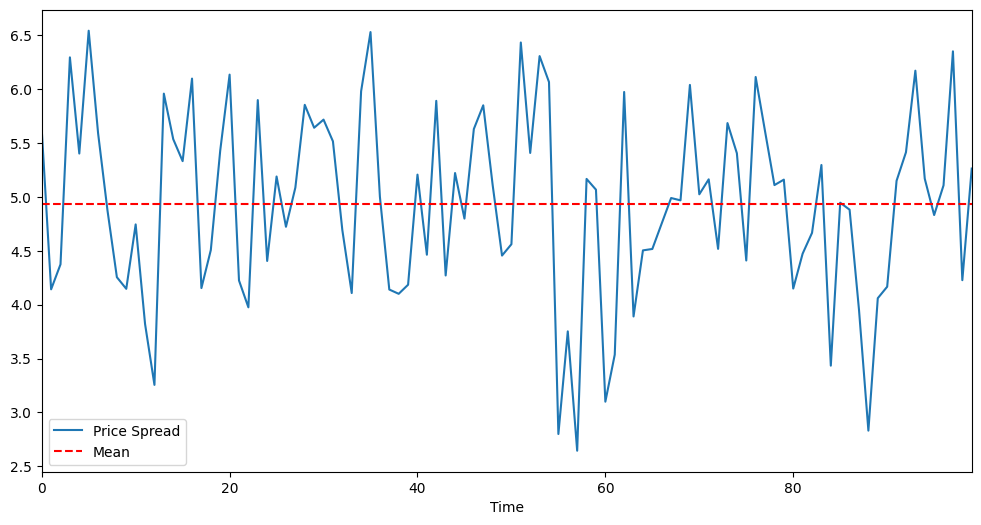
With a low value for test p-value, we cannot reject the cointegration the hypothesis of residuals being I(0) - stationarity.

Código
plt.figure(figsize=(12,6))
(Y - X).plot() # Plot the spread
plt.axhline((Y - X).mean(), color='red', linestyle='--') # Add the mean
plt.xlabel('Time')
plt.xlim(0,99)
plt.legend(['Price Spread', 'Mean']);

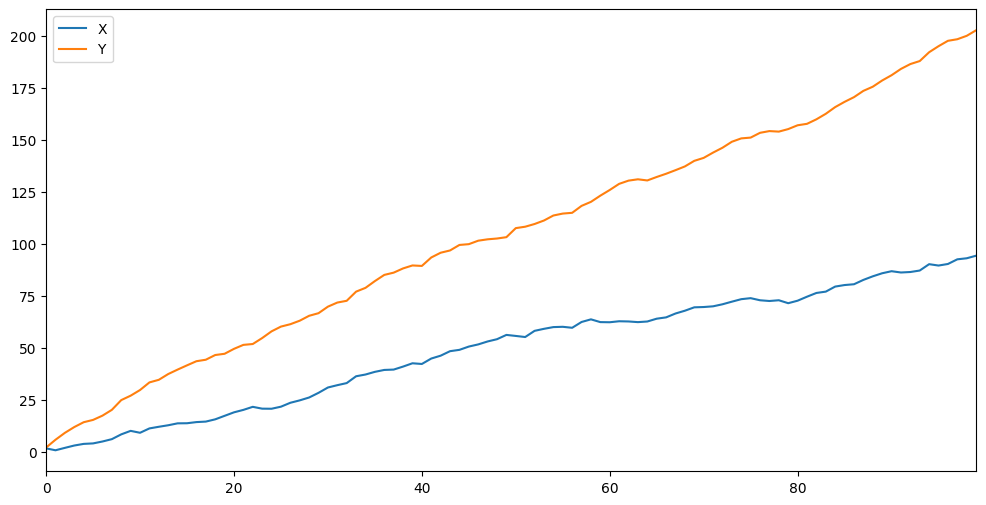
Correlation is not cointegration:

Another simulates example is the following:

Código
X_returns = np.random.normal(1, 1, 100)
Y_returns = np.random.normal(2, 1, 100)

X_diverging = pd.Series(np.cumsum(X_returns), name='X')
Y_diverging = pd.Series(np.cumsum(Y_returns), name='Y')


pd.concat([X_diverging, Y_diverging], axis=1).plot(figsize=(12,6));
plt.xlim(0, 99)

Código
print('Correlation: ' + str(X_diverging.corr(Y_diverging)))
score, pvalue, _ = coint(X_diverging,Y_diverging)
print('Cointegration test p-value: ' + str(pvalue))
Correlation: 0.9936099205123949
Cointegration test p-value: 0.7523500720747303

Real example:

Now a real example of detecting pair trading strategies.

Código
start = datetime.datetime(2013, 1, 1)
end = datetime.datetime(2018, 1, 1)

ticker_list = ['AAPL', 'ADBE', 'ORCL', 'EBAY', 'MSFT', 'QCOM', 'HPQ', 'AMD', 'IBM', 'SPY']

df = yf.download(ticker_list, start=start, end=end)['Close']
Código
df
Ticker AAPL ADBE AMD EBAY HPQ IBM MSFT ORCL QCOM SPY
Date
2013-01-02 16.612209 38.340000 2.53 20.143671 4.630522 113.857239 22.242884 28.839972 45.717426 116.953865
2013-01-03 16.402523 37.750000 2.49 19.715164 4.667517 113.231010 21.944916 28.524071 45.505615 116.689621
2013-01-04 15.945637 38.130001 2.59 19.839211 4.667517 112.488739 21.534203 28.773472 44.834850 117.202103
2013-01-07 15.851841 37.939999 2.67 20.113605 4.676767 111.995857 21.493935 28.623833 45.194942 116.881821
2013-01-08 15.894504 38.139999 2.67 19.801622 4.744590 111.839302 21.381193 28.632137 45.124340 116.545525
... ... ... ... ... ... ... ... ... ... ...
2017-12-22 40.985916 175.000000 10.54 33.723557 16.513344 102.822487 78.645721 42.007748 52.838741 236.793823
2017-12-26 39.946098 174.440002 10.46 33.884304 16.490046 103.045013 78.544533 42.069832 52.487728 236.510590
2017-12-27 39.953129 175.360001 10.53 33.589596 16.521111 103.247269 78.829651 42.025471 52.683643 236.625656
2017-12-28 40.065544 175.550003 10.55 33.866447 16.427904 103.860840 78.838844 42.149654 52.553032 237.112488
2017-12-29 39.632286 175.240005 10.28 33.705700 16.319162 103.442802 78.673302 41.936779 52.259182 236.218445

1259 rows × 10 columns

Código
# function to build log returns from a dataframe
def log_returns(df):
  import numpy as np
  df_ = df.copy()
  for stock in df.columns:
      df_[stock] = np.log(df_[stock]).diff()
  return df_.dropna()
Código
# applying the function
daily_returns = log_returns(df)
daily_returns
Ticker AAPL ADBE AMD EBAY HPQ IBM MSFT ORCL QCOM SPY
Date
2013-01-03 -0.012703 -0.015508 -0.015937 -0.021502 0.007958 -0.005515 -0.013487 -0.011014 -0.004644 -0.002262
2013-01-04 -0.028250 0.010016 0.039375 0.006272 0.000000 -0.006577 -0.018893 0.008706 -0.014850 0.004382
2013-01-07 -0.005900 -0.004995 0.030421 0.013736 0.001980 -0.004391 -0.001872 -0.005214 0.007999 -0.002736
2013-01-08 0.002688 0.005258 0.000000 -0.015633 0.014398 -0.001399 -0.005259 0.000290 -0.001563 -0.002881
2013-01-09 -0.015752 0.013542 -0.015095 0.001517 0.029452 -0.002856 0.005634 0.000581 0.015063 0.002539
... ... ... ... ... ... ... ... ... ... ...
2017-12-22 0.000000 0.002517 -0.032667 -0.001323 0.000470 0.006579 0.000117 0.001691 0.005267 -0.000262
2017-12-26 -0.025697 -0.003205 -0.007619 0.004755 -0.001412 0.002162 -0.001287 0.001477 -0.006665 -0.001197
2017-12-27 0.000176 0.005260 0.006670 -0.008736 0.001882 0.001961 0.003623 -0.001055 0.003726 0.000486
2017-12-28 0.002810 0.001083 0.001898 0.008208 -0.005658 0.005925 0.000117 0.002951 -0.002482 0.002055
2017-12-29 -0.010873 -0.001767 -0.025926 -0.004758 -0.006641 -0.004033 -0.002102 -0.005063 -0.005607 -0.003778

1258 rows × 10 columns

Código
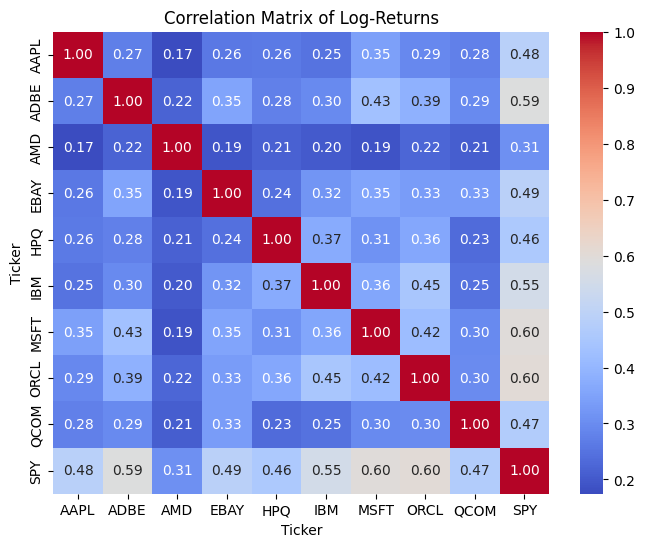
# matrix correlation of log-returns

import seaborn as sns
correlation_matrix = daily_returns.corr()
plt.figure(figsize=(8, 6))
sns.heatmap(correlation_matrix, annot=True, cmap='coolwarm', fmt=".2f")
plt.title('Correlation Matrix of Log-Returns')
plt.show()

Function to detect cointegrated pairs:

Código
def find_cointegrated_pairs(data):
    n = data.shape[1]
    score_matrix = np.zeros((n, n))
    pvalue_matrix = np.ones((n, n))
    keys = data.keys()
    pairs = []
    for i in range(n):
        for j in range(i+1, n):
            S1 = data[keys[i]]
            S2 = data[keys[j]]
            result = coint(S1, S2)
            score = result[0]
            pvalue = result[1]
            score_matrix[i, j] = score
            pvalue_matrix[i, j] = pvalue
            if pvalue < 0.05:
                pairs.append((keys[i], keys[j]))
    return score_matrix, pvalue_matrix, pairs
Código
scores, pvalues, pairs = find_cointegrated_pairs(df)
pairs
[('AAPL', 'ORCL'),
 ('AAPL', 'SPY'),
 ('ADBE', 'EBAY'),
 ('ADBE', 'MSFT'),
 ('EBAY', 'MSFT'),
 ('HPQ', 'ORCL')]
Código
# picking one example
S1 = df['ADBE']
S2 = df['MSFT']

score, pvalue, _ = coint(S1, S2)
pvalue
np.float64(0.003089062812445259)
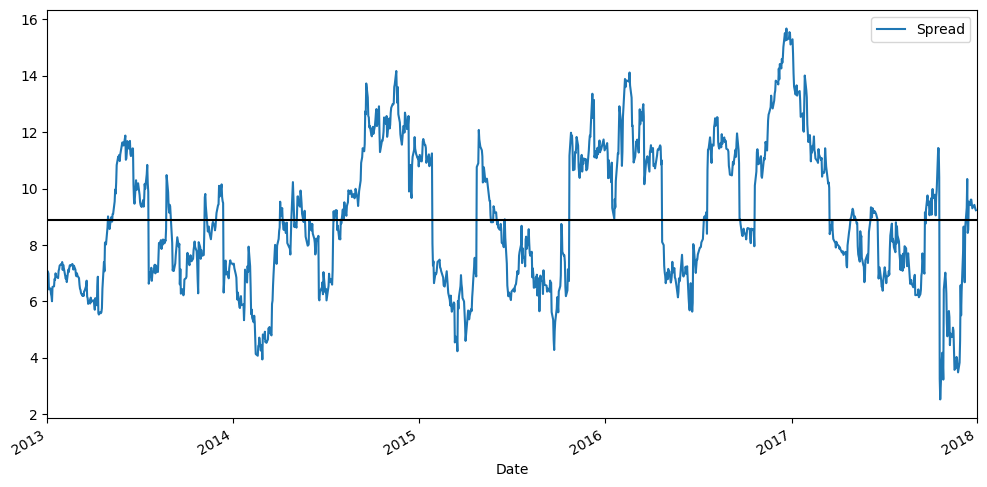
Código
S1 = sm.add_constant(S1)
results = sm.OLS(S2, S1).fit()
S1 = S1['ADBE']
b = results.params['ADBE']

spread = S2 - b * S1
spread.plot(figsize=(12,6))
plt.axhline(spread.mean(), color='black')
plt.xlim('2013-01-01', '2018-01-01')
plt.legend(['Spread']);

Explanation of the meaning of “trading the spread”:

In a cointegrated pair trading strategy, ‘trading the spread’ refers to exploiting the long-term, statistically stable relationship between the prices of two cointegrated assets. Here’s a breakdown:

Cointegrated Pair: When two (or more) non-stationary time series are cointegrated, it means they move together in the long run, and a linear combination of them is stationary. This stationary linear combination is often referred to as the ‘spread’ or ‘error correction term’. Even though individual asset prices might wander, their relationship tends to revert to a mean.

The Spread: The ‘spread’ is typically defined as the difference between the price of one asset and a scaled price of the other asset (e.g., Spread = Price_Y - beta * Price_X, where beta is the hedge ratio obtained from a regression, as we saw with b for ADBE and MSFT). Because the assets are cointegrated, this spread is expected to be stationary, meaning it will fluctuate around a constant mean.

Trading the Spread Strategy (Mean Reversion):

Execution:

When the spread deviates significantly above its historical mean (meaning one asset is relatively overvalued compared to the other), you would sell the overvalued asset and buy the undervalued asset. For example, if Price_Y - beta * Price_X is high, you’d sell Y and buy X.

Closing Position: The goal is to profit when the spread reverts to its mean. Once the spread returns to its average, you would close both positions, realizing a profit.
De volta ao topo